
I’ve known Alan Chapell since back in the day when we overlapped at Jupiter Research. I have been a listener of his podcast, The Monopoly Report, since it began. He’s a privacy and regulatory expert who’s been in digital media since 1997, and we had a great conversation which I just posted on the Won’t Fix website (updated with transcripts of my past episodes now too).
I wanted to get him on to talk about residential proxy networks, aka “rent out your bandwidth for fun and profit” and its historical comparison to adware .. if anyone here remembers Gator/Claria, Zango or WhenU?! Who knew this software might be renting out your TV’s internet connection without you knowing about it!
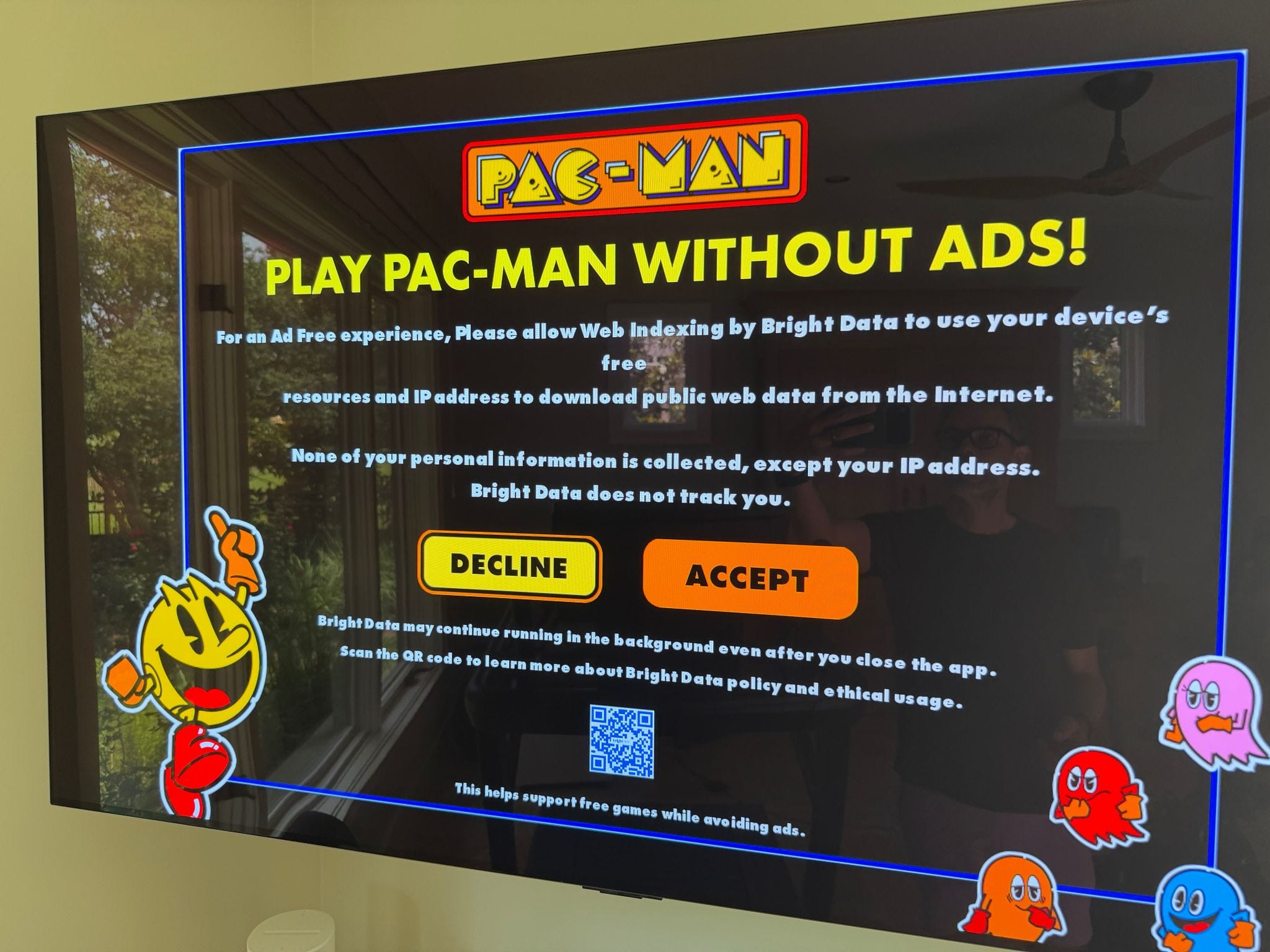
Source: Rob Leathern, June 2026
I took this photo of this ‘offer’ on an officially licensed Pac-Man game on my own TV on June 25th, just before Brian Krebs used a similar photo to cover underlying research that claimed a large share of the apps in LG’s webOS store were routing traffic for unknown third parties. LG later announced** it won’t allow its TVs to be used for residential proxy apps like Bright Data’s, and my TV appeared to force-update the games software to a new version.
The general idea: to skip ads in a game on your connected TV, you (or perhaps one of your family?) could install an SDK that then hands out access to your home IP address to a variety of unknown parties, including when the set is switched off. The television is an attractive host: it can keep serving proxy customers while the screen is dark. The game in question is popular and free, and installing it simply requires an LG account. Creating an account just takes an email and a date of birth (with nothing verifying the latter). Related - see how I requested my TV watching data from LG back in Rob’s Notes 13.
Alan and I talked about the historical analogs to adware where at least you got a branded pop-up, which was awful, but it was a foothold to click through to un-consent. Alan went further than I did: the adware companies eventually shipped opt-out tools, buried in dark patterns and unreliable, but they existed. He can’t find the equivalent here. And as he put it, the fact that his six-year-old managed to turn something on doesn’t mean the household consented to it.
Of course it’s never that simple
Working on trust and safety I can verify that, as Alan said, some fraud prevention flows run on exactly this kind of infrastructure, including at some of the largest platforms. Big companies hold their nose and buy from these proxy providers because the bad actors are using similar means to defeat detection. It’s a classic arms race or “one way ratchet”.
We quickly got to the KYC topic - know your business for the buyers, know your customer for the people consenting, actually verifying age. Alan likes the KYC idea and thinks age verification is coming regardless of the value. His line, which I enjoyed: he doesn’t want to get into an arms race with a 16-year-old, because he’ll lose.
Where that ends may be showing a government ID to browse the web. He thinks this consumes the internet’s attention in ‘27 and ‘28. I covered some of it in Rob’s Notes 25.
On making podcasts
The last stretch of our conversation was about the podcast craft, and I found it useful as someone still early in this journey. Alan books people who are known enough that others want to hear them but who can actually engage the issues — and he prizes guests willing to speak recklessly. So do I of course, so please if you know anyone who is an expert about AI/trust/safety/privacy topics and would do so, send me a DM!
And of course, please send me your feedback about this and my other recent conversations.
**Quote in header: LG Senior Vice President John Taylor told Krebs: “A residential proxy network is not an intended use for LG smart TVs, and LG Electronics is working with developers to remove the residential proxy option from their apps on the webOS platform,” Taylor said. “If this option is not removed, these apps will be suspended.”
Show Page: Won’t Fix Episode 13
Listen to the full episode: YouTube · Spotify · Apple Podcasts